THIS MONTHS NEWSLETTER:
- Article: What AI means for ownership and authenticity...
- Podcast: The Truth About Corporate Innovation
- Guest Appearance: The Right Place Podcast
- Exclusive subscriber offer...
I’ve never felt the urge to talk much about AI, even though I’d argue I’m more qualified than most.
Not because I’m hiding anything, but because the space is overflowing with the same predictable takes:
- AI equals efficiency.
- Efficiency equals productivity.
- Productivity equals progress.
It’s all a little too neat and obvious. And honestly, a little boring.
But through my recent peer discussions on the topic, I’ve noticed that the conversations that are sparking the most heat always inevitably return to two questions:
- What does AI mean for ownership?
- What does AI mean for authenticity?

AI Content vs Original Thought Leadership: A 500-Year Whiplash
To understand what’s actually going on with ownership and authenticity, you can’t look at the last decade. You have to look at the last five centuries.
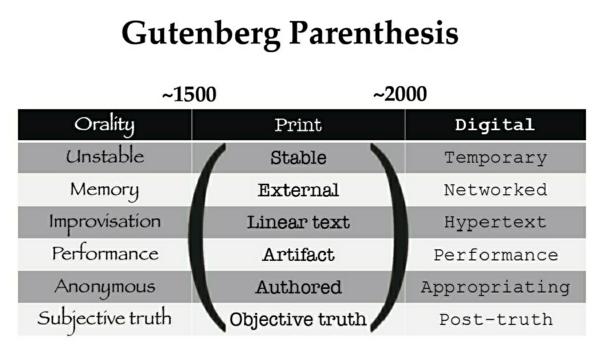
For the last 500 years, we’ve lived inside what scholars call the Gutenberg Parenthesis-a world defined by printing press where:
- Texts were stable.
- Authorship was fixed.
- Originality was clear
- Information was “finished”
- Ownership was solid and traceable
Our entire modern understanding of plagiarism, authorship, ownership, and intellectual property comes from that era.
But the Parenthesis is closing.
AI didn’t start this shift—social media has been chipping away at it for years—but AI has accelerated it to a speed impossible to ignore. We have officially left the world of fixed information and stepped into an era where creation is fluid, iterative, and never truly finished.
The disruption people are feeling right now isn't an existential threat from software. It’s the cultural whiplash of leaving a 500-year mindset behind.
Why the AI and Authenticity Debate Gets So Heated
1. The Death of Ownership as Property
The ownership debate only exists because we were raised to believe that information behaves like physical property—fixed, finite, and enforceable.
That world is dissolving. We are shifting from ownership as possession to ownership as relationship. The idea that a single person, model, or company can hold an airtight, permanent claim over a piece of information is increasingly out of sync with digital culture. The real question for businesses today is no longer "Who owns this?" but "How does this information create actual value in practice?"
2. The Migration of Authenticity
People think AI threatens authenticity, but the truth is simpler: authenticity no longer lives inside the content itself.
In a world where information is fluid and endlessly remixable, you cannot rely on being the first to say something. The real power of authenticity now comes from your ability to own your thoughts and articulate them with clarity, conviction, and nuance.
The work is entirely internal:
-
Understanding your unique voice.
-
Forming deeply considered opinions.
-
Separating your core thinking from the sea of copycats.
AI didn’t weaken authenticity. It exposed who never developed it in the first place.
How to Write Thought Leadership in the Age of AI
When we debate ownership and authenticity in the context of AI, we aren’t really having a debate about technology at all. We are witnessing the collapse of a historic mental model.
The digital era has returned us to a pre-print state of information: one defined by fluidity, constant iteration, and collective reinterpretation. In this environment, the value of an idea no longer comes from holding onto it. It comes from how you express it, interpret it, and execute it.
AI has made mediocrity obvious.
The long-term advantage belongs exclusively to those who can take ownership of their own opinions, articulate nuance, and communicate their position with psychological depth.
AI can generate endless content, but it cannot generate the depth of lived human experience or expression. That remains our responsibility. The leaders and businesses who thrive in this new environment won’t be the ones clinging to what they own, but the ones investing in how they think.
🍊Creative Business is brought to you by Tomorrow | B2B Marketing & Communications.