How To Scale Content Marketing (B2B)

For business leaders scaling beyond $1M, consistent marketing execution can be a challenge.
In those early stages, you're buried in sales and operations and as your company pushes past that $1M mark, you realise you have no way of meaningfully scaling your message that got your business to the stage it's at already.
What is a B2B Content Strategy?
A B2B content strategy framework is an operational system that locks your messaging parameters before testing formats. By holding the message constant and treating format as a variable, you protect narrative positioning, lower Customer Acquisition Cost (CAC), and scale investment using empirical data.
1. Why B2B Content Strategies Fail
Most founders would assume that putting parameters around content would stifle creative execution. In reality, uncontrolled creative freedom is what destroys marketing's operational efficiency.
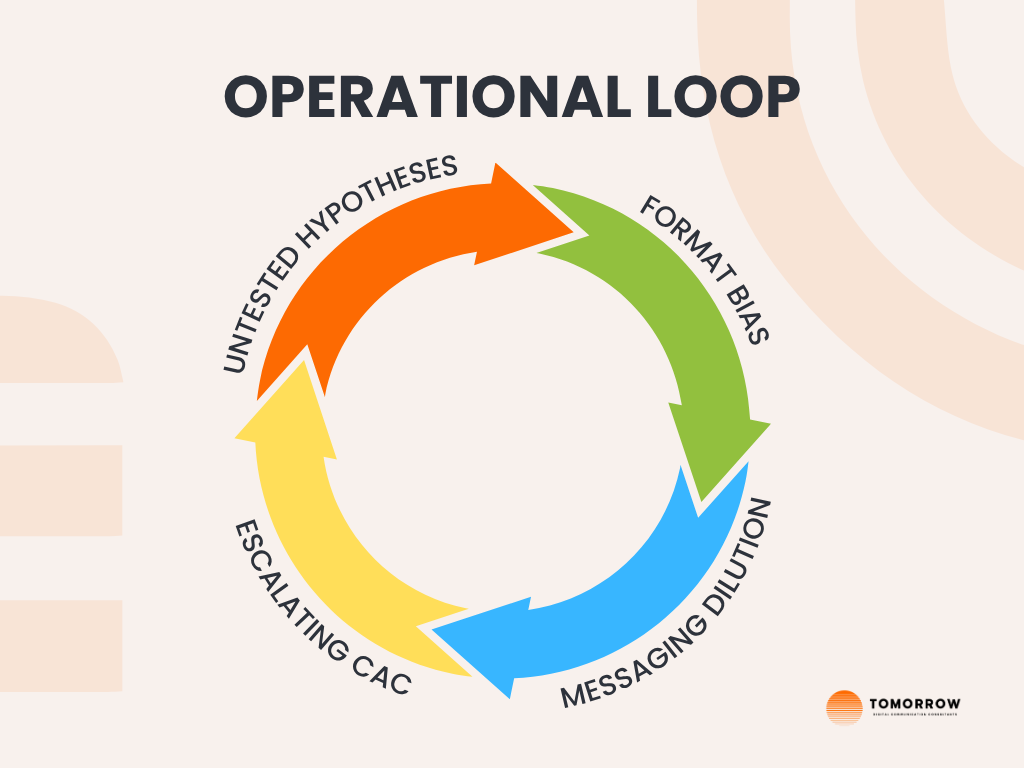
When a $1M–$10M company operates without a structured content framework, it enters an expensive operational loop, penalising the business in three distinct ways:
- Message Dilution: Without established boundaries, your messaging inherently lacks clear market positioning. This creates constant internal friction over what to post, why you are posting it, and what commercial result you actually expect to achieve.
- Format Biases: Creatives default to what they enjoy making. Video editors assume your buyers only watch video; writers assume everyone reads long-form essays. The result is your capital gets allocated based on employee biases rather than empirical buyer data.
- Zero Institutional Learning: When a campaign succeeds or fails, nobody truly knows why. Was it the offer, the platform, the message, or the media type?
Operating without narrative boundaries means your marketing cannot learn. It simply repeats a process that results in inflated Customer Acquisition Cost (CAC) and wasted payroll.
2. Messaging: Setting Creative Boundaries.
Scaling a marketing function is the balancing act of managing creativity with scientific discipline.
In scientific tests, we all know that changing multiple variables simultaneously invalidates the experiment. If your value proposition changes every time you write an article or shoot a video, your analytics become meaningless.
Before a line of copy is drafted, leadership must lock down the company's Foundational Positioning Formula:

This positioning is operationalized through a Message Mapping Workshop.
An exercise where leadership and marketing collaborate to build your narrative architecture—identifying the exact topics you need to talk about, the specific commercial value those topics deliver, and how they explicitly answer the question of who you are, what you do, and who you serve.
Three Rules of Narrative Alignment
- Establish Narrative Value: Map out the exact themes your brand has the authority to talk about, while explicitly removing out-of-scope topics that dilute your positioning.
- Lock Core Messaging: Ensure your core messaging remains constant across every format and channel.
- Control the Content Lifecycle: Enforce narrative alignment across the entire operational chain:

When messaging is aligned, every content format—from a 30-second reel to a long-form article—communicates a consistent, recognizable position.
ENQUIRE HERE 👉🏼 FACILIATED MESSAGE MAPPING WORKSHOPS

3. Repurposing B2B Content
Once your messaging boundaries are locked in, it’s time to educate yourself. A mature marketing function never assumes it knows the exact format a decision-maker prefers to consume information. Sales feedback and buyer personas offer initial hypotheses, they are not empirical proof.
Consider your buyers: A CEO might skim a text summary between client meetings. A CFO might listen to an audio breakdown on their commute. A Head of Engineering might review a visual slide deck over a weekend coffee.
Instead of betting your marketing budget on a single medium, deploy a Format-Agnostic Repurposing Workflow:
- Establish Format Agnosticism: Treat every media format as an experimental variable.
- Deconstruct Baseline Assets: Extract a single, high-value long-form asset and adapt it into parallel executions across short-form video, text, and visual summaries.
- Run Parallel Tests: Launch these variations across channels to observe true user behaviour while holding your core narrative stable.
4. Measuring Content Success
By holding the core message constant, engagement metrics transform from vanity counters into actionable market intelligence.
You stop asking subjective questions and start measuring empirical reality: how your audience actually prefers to consume your message.
Evaluating lead metrics (impressions, watch times, CTR) across formats provides the empirical evidence for resource allocation—telling you precisely where to double down on future time and budget. Optimizing these leading signals directly compounds your lag metrics (qualified pipeline and revenue).
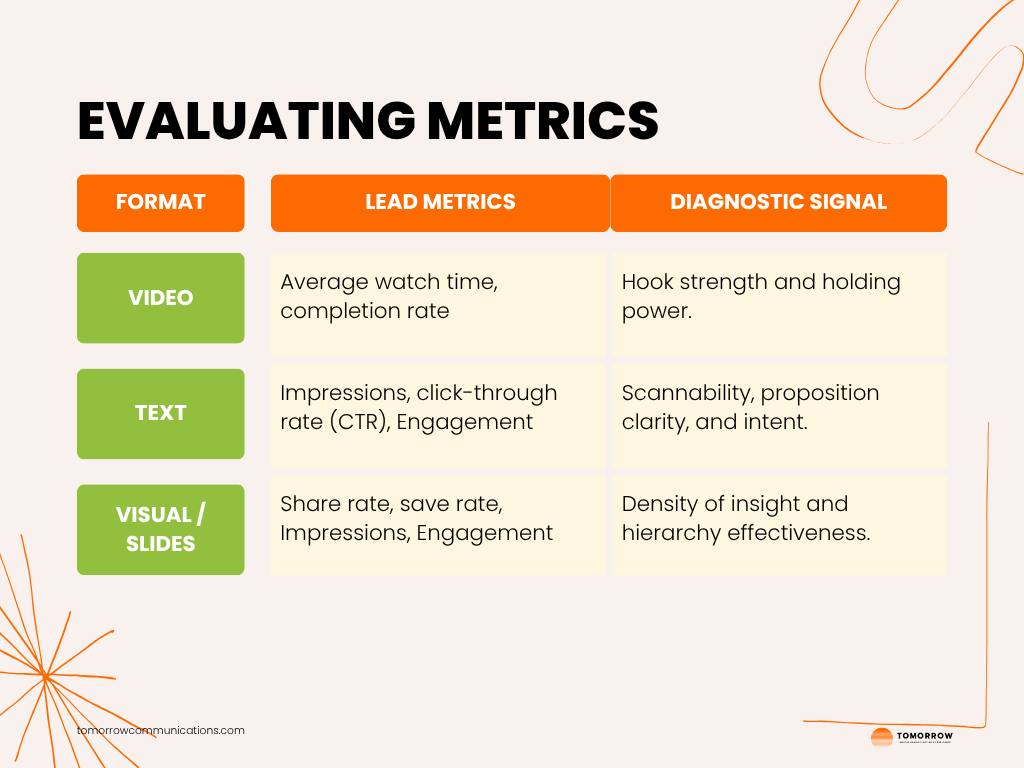
Key Takeaway: Use lead metrics to guide future capital allocation, but avoid permanently writing off any format based on a single test. B2B buyer habits evolve alongside platform algorithm shifts.
5. What Changes When You Control Content
Transitioning to a controlled, format-agnostic content strategy isn't just a process change—it is an upgrade to your company's operational maturity. It shifts your marketing department from an expensive creative gamble into a high yielding , data-driven intelligence function.
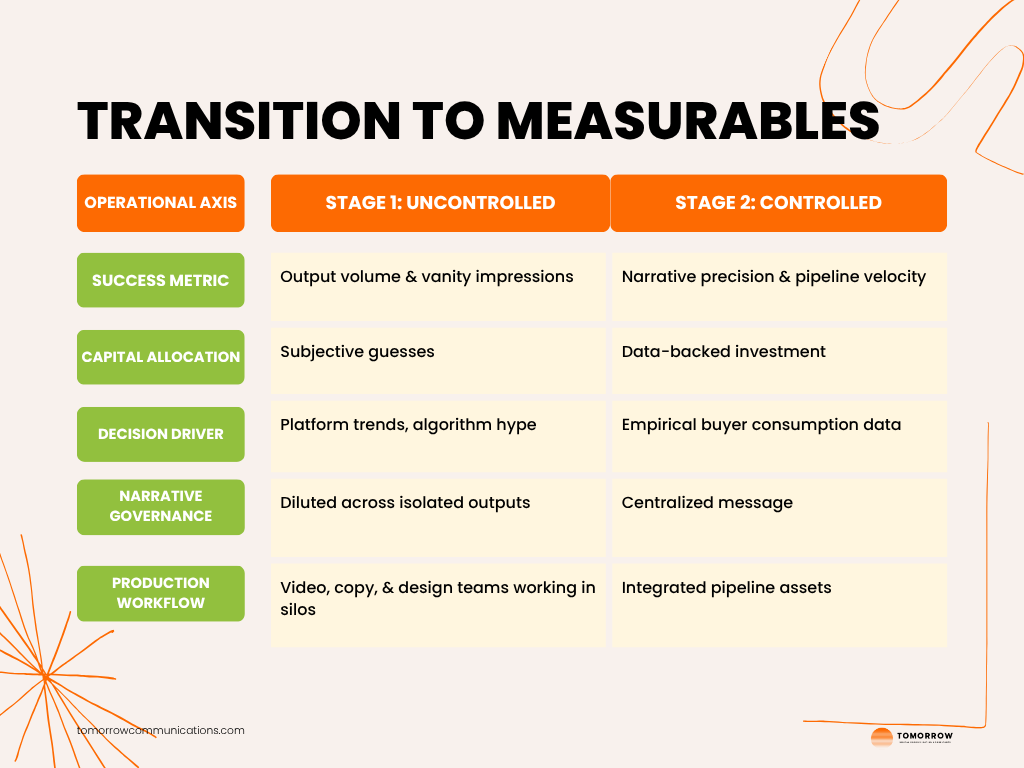
When you eliminate the guesswork, your marketing function systematically tests, learns, and scales your message to the exact buyers you want driving your business forward.
Content Demands Discipline
Reaching your ideal customer isn't about producing a higher volume of content. It is about operational discipline.
By locking your core ideas within firm messaging boundaries and systematically testing format executions against empirical data, you transform the content creation process from a creative gamble into measurable growth.
ABOUT US
DIGITAL MARKETING CONSULTANTS
Tomorrow embed inside $1M–$10M professional services to turn complex expertise into high-converting content systems that capture attention and drive growth.