Why Conflict is The Key to Cultural Innovation
The standard playbook for workplace conflict resolution prioritizes speed: resolve the issue quickly, quiet the disruption, and restore business as usual. But what if rushing to resolve tension is actually robbing your business of the opportunity to innovate?
In this Creative Business episode, Brad Eather joins Conflict Transformation Consultant Kate Russell to challenge traditional leadership assumptions about conflict in the workplace.
Drawing from over three decades of workplace mediation practice, Russell reveals how effective conflict resolution strategies require leaders to step back, explore the underlying causes of friction, and use conflict as the tool for cultural change.
LISTEN HERE
Unpacking the Root Causes of Conflict in the Workplace
When organizations bring in external support to help manage a workplace conflict, they typically assume they are dealing with a simple clash of personalities or a single "problem person". Russell notes that these types of interpersonal disputes are almost always a symptom of systemic operational or leadership failures.
Leadership Fallibility:
Leaders frequently contribute to conflict unintentionally. Unclear job roles, ambiguous corporate visions, implicit favouritism, or tolerating poor conduct quietly seeds resentment across a team.
Systemic Friction:
Singling out individual employees to resolve disputes is guaranteed to fail. Employees will recognize conflict issues are broader than their personal relationships. Holding them personally responsible for systemic failures results in talent walking out the door.
Diagnostic Approach:
Effective conflict resolution strategies begin by de-escalating the emotional temperature. Individual consultations where employees can vent freely and have their lived experiences validated. Once trust is built, leaders and team members can shift the conversation away from a position of emotional defensiveness toward an objective analysis of the issues root causes.
Effective Conflict Resolution Strategies for Leaders
To take a proactive approach to conflict resolution, you must first dismantle what has likely become an internal culture of blame. But where does blame culture begin? More often than not, it starts at the top.
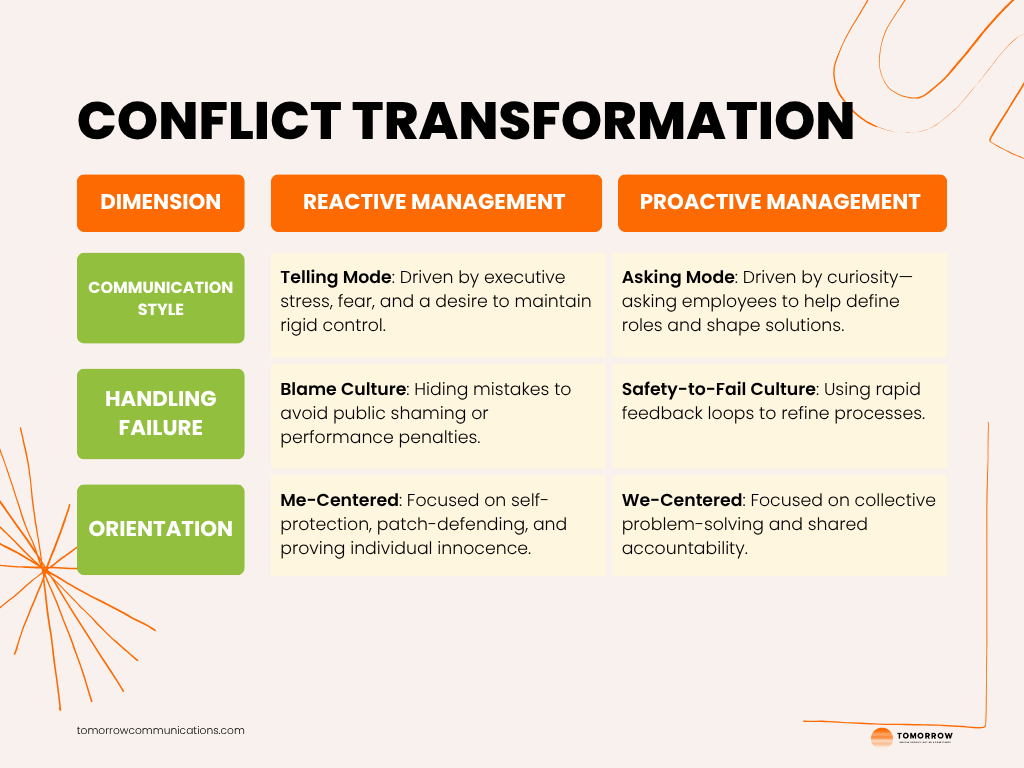
When leadership insists on being perfect, right, and in control, they leave zero operational space for anyone else to be anything but wrong. These impossible standards force employees into defensive postures—prompting them to hide missteps to avoid penalties rather than engaging in early, honest communication.
To break this dynamic, leaders must transform how they communicate, handle failure, and structure team dialogue:
Reframing conflict in the workplace requires leaders to shift how they view friction entirely.
Russell reframes, conflict is a gift: "it is a diagnostic alarm signalling that an operational process or boundary has failed, not that a person is inherently flawed. When leaders trade the need to be right for intellectual curiosity, team dynamics naturally shift from defensive fear into collaborative problem-solving. "
Shifting from Reactionary Management to Leadership Accountability
When managers operate under constant stress, they naturally default to a micromanaging "telling" mode in a false attempt to maintain control. This reactionary state inadvertently fuels workplace conflict, stripping teams of autonomy and psychological safety. To build a sustainable conflict resolution strategy, leaders must move away from top-down mandates and embrace an "ask, don't tell" approach
Practicing Self-Care & Boundary Setting
Leaders who struggle to regulate their emotions create unsafe environments where employees never know which version of the boss will show up. Setting firm boundaries—like limiting constant availability—helps leaders manage overwhelm and consistently bring their best selves to work.
Establishing Rules of Engagement:
Rather than dictating behaviour from above, leaders should facilitate sessions where teams collectively set their own communication rules. Co-creating these standards establishes clear channels, peer accountability, and explicit protocols for addressing missteps.
Clarifying Roles Through Discussion:
Instead of handing down rigid responsibilities, leaders must involve employees in two-way discussions to define expectations together. Asking staff how they interpret their roles during one-on-ones exposes communication gaps and aligns expectations without introducing blame.
WATCH SEGMENT
Achieving Horizontal Executive Alignment Sustains Cultural Change
Workplace conflict resolution cannot operate solely as a bottom-up initiative; it demands alignment across the executive suite. During periods of rapid organizational growth, business leaders often fall into the trap of managing in vertical silos, inadvertently creating friction that cascades down through the hierarchy.
Horizontal Executive Alignment Over Silos:
While vertical management within a department is common, the C-suite must operate as the organization's primary team. When executives defend their own patches or display passive-aggressive tension, downstream employees internalize that friction, leading to inter-departmental conflict.
Eliminating "Agree to Disagree":
Settling for polite disagreement in executive meetings creates structural fault lines. Effective leadership requires engaging in rigorous, healthy conflict until authentic consensus is reached. This eliminates damaging workplace gossip and builds alignment from the top down.
Prioritizing Connection Over Tasks:
Sustaining long-term cultural change requires slowing down processes to build authentic human connection. Incorporating low-pressure interactions—such as walking meetings—provides teams with the trust and frameworks needed to navigate uncomfortable feedback constructively.
Managing conflict in the workplace is ultimately not about applying superficial band-aids to systemic problems. By asking more, telling less, and balancing task execution with genuine human connection, leaders can leverage workplace friction to forge a highly aligned, resilient, and innovative corporate culture.
ABOUT US
DIGITAL MARKETING CONSULTANTS
Tomorrow embed inside $1M–$10M professional services to turn complex expertise into high-converting content systems that capture attention and drive growth.