The Truth About Corporate Innovation Theatre: Why Processes Fail and Skills Save ROI
"Innovation" is arguably the most expensive buzzword throwing corporate budgets off course.
Companies love to claim industry-disrupting status, yet a staggering 90% of corporate executives report deep dissatisfaction with their innovation outcomes. According to thought leader and author Christopher Sellers, the root cause of this systemic failure isn't a lack of smart people or funding—it is the widespread adoption of Corporate Innovation Theatre.
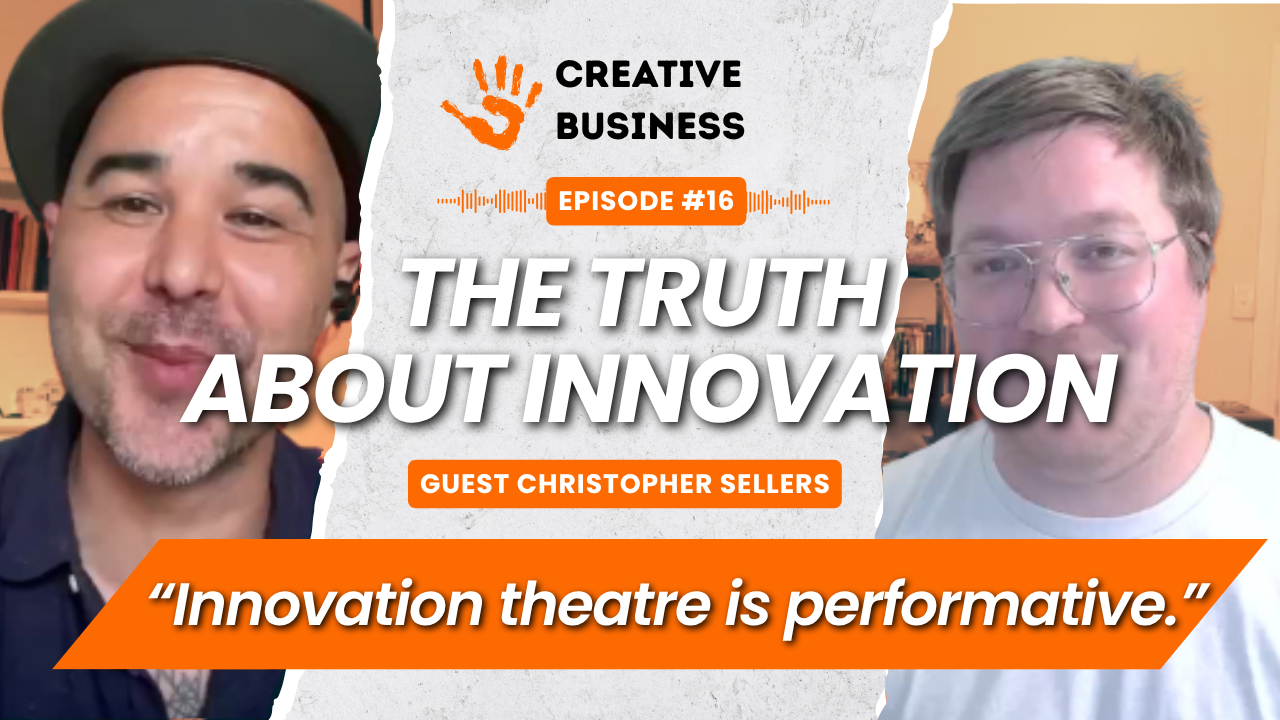
In this episode of Creative Business Podcast, Host Brad Eather and Sellers pulls back the curtain on why traditional workshops fail, how to distinguish incremental innovation from true originality, and why treating creative intelligence as a learnable language is the key to business differentiation.
LISTEN HERE
Dismantling Corporate Innovation Theatre: Why Workshops Fail
Most professionals have experienced the classic brainstorming ritual: a room filled with cross-divisional teams, colourful post-it notes, a skilled facilitator, and "blue-sky" thinking. The energy is high, team cohesion feels excellent, and everyone walks away assuming change is imminent.
The next day, however, implementation hits a wall.
"It is a performative assumption that if we just throw enough raw ideas at the wall, a good one will magically emerge and we'll execute it," Sellers notes. "When you are talking about massive budgets where you actually need to consistently execute and deliver an effective, industry-disrupting solution, these workshops are the most inefficient, expensive ways to go about it."
This disconnect occurs because corporate and STEM fields treat innovation as a formulaic workflow process. The assumption is that the right step-by-step template will guarantee a 100% success rate. In reality, skills drive the process, not the other way around.
Sellers argues that while businesses have an abundance of technical skills, they suffer from a severe deficit in creative skills.
The Six Competencies of Creative Intelligence
To move away from performative design thinking, Sellers suggests leaders must cultivate Creative Intelligence within their teams. He breaks this down into six learnable competencies that stretch beyond traditional problem-solving:
- Problem Solving: The baseline ability to fix a visible, broken mechanism.
- Innovation: The capacity to take an existing product or framework and incrementally improve it.
- Emotional Intelligence: The relational awareness required to read between the lines of data.
- Adaptability: The reactive skill to dynamically pivot in real-time under changing circumstances.
- Composition: The proactive skill of mapping transferable concepts from entirely separate industries to solve local bottlenecks elegantly.
- Originality: The elite ability to design entirely new concepts from a blank canvas.
Innovation vs. Originality: The Low-Hanging Fruit
Sellers challenges executives to stop hiding behind 1% incremental variations. Traditional corporate spaces favour incremental innovation because it feels safe, but it often amounts to high-school-level logic.
For instance, Uber didn't invent ride-sharing conceptually; the horse-and-carriage model already proved the core human need. Instead, they combined that insight with mobile technology to permanently disrupt transport. True commercial dominance requires stepping past basic patches and learning to create original frameworks from scratch.
WATCH CLIP
Harnessing Emotional Intelligence & "Script Analysis" for Data
One of the most immediate practical applications of creative intelligence sits within customer discovery and User Experience (UX).
Business leaders with high-level emotional intelligence understand that consumer feedback shouldn't always be taken literally.
Sellers draws a parallel to theatrical script analysis. Just as an actor evaluates a script to uncover hidden motivations and "grey data" that aren't explicitly written in the dialogue, a business analyst must look beneath surface-level data points.
"In the banking sector, customers might endlessly complain that banking fees are too high or that the app is too difficult to navigate," Sellers explains. "But if you scratch beneath the surface, you realize the root issue is that they don't fundamentally trust banks. Trust is the real problem."
When a sales or product development team can accurately diagnose those underlying emotional needs, they gain unique, highly valuable insights that competitors miss, paving the way for innovations customers are thrilled to purchase.
Training Adaptability: From Jazz Improvisation to Crisis Response
A common myth in the corporate world is that true creativity cannot be taught. Sellers rejects this outright, pointing to structural theatre improvisation as a prime example of trained adaptability.
In pure improvisation, performers follow strict rules to build momentum and respond to unpredictable setups in real-time. This same cognitive reflex is what keeps military operatives, first responders, and emergency healthcare workers operational when faced with real-world crises.
When the pandemic forced global markets to shift, the widespread corporate panic highlighted a systemic lack of this exact adaptability reflex. Businesses treated "pivoting" as an empty buzzword because their teams lacked the creative training required to process chaos and execute fluidly.
Constructive Constraints: Turning Ideation into Execution
To safely inject creative problem-solving into a rigid enterprise framework, leaders must flip their traditional project management methodologies.
Standard corporate thinking defaults to looking at limited resources, time horizons, and budgets first, forcing the idea to fit inside an uninspired box. Sellers advocates for a three-step diagnostic parameter to break the performative cycle:
- Identify the exact target: Are you delivering a specific project, solving a concrete problem, or escaping a stuck market position?
- Define the ideal destination: Outline a bold, seemingly impossible star on the horizon without letting current constraints restrict imagination.
- Apply the constraints last: Wrap that uncompromised vision in your hard timeline, budget, and resource limitations.
By using resource limitations as creative constraints rather than initial filters, teams are forced to think outside their sandbox. They start looking at how completely unrelated industries solve similar data overflows or how processes could be simplified to achieve the same outcomes.
Achieving Fluency in the Language of Creativity
Chris argues that creativity should not be evaluated strictly for instantaneous, short-term outputs like a flash marketing campaign or a patch fix. Its true corporate power lies in its utility as an interpretive lens to translate, process, and rapidly master complex variables in a changing world.
"Creativity is a language," says Sellers. "It has its own strict structural rules, grammar, syntax, pronunciation, and linguistics. And just like any foreign language, you can learn it and achieve absolute fluency."
For corporate executives overseeing innovation investments scaling into millions of dollars, the mandate is clear: move away from the performative loops of corporate innovation theatre, bypass defensive checks and balances, and partner with fluent creative intelligences capable of driving true operational execution.
To hear more conversations exploring the intersection of creativity and commerce, subscribe to the Creative Business podcast on your preferred podcast platform.
ABOUT US
DIGITAL MARKETING CONSULTANTS
Tomorrow embed inside $1M–$10M professional services to turn complex expertise into high-converting content systems that capture attention and drive growth.