LinkedIn Employee Engagement Strategy (That Actually Works)
If you're a marketing manager who has ever asked your team for a little company post love, you know how frustrating it is to be met with radio silence.
When your own colleagues scroll past your content, it’s easy to blame external factors: “LinkedIn isn't reaching our audience,” or “Organic reach is dead.”
But the algorithm isn’t your primary problem here—human psychology is.
To build a high-performing social media employee engagement strategy, leaders need to shift their mindset to the fundamentals. This isn't about changing employee behaviour—it's about making their existing online habits more productive.
Your team is already scrolling, reading, and interacting on social media throughout the day. You don't need to force a new routine or mandate compliance; you simply need to leverage their existing online presence by applying the First Follower psychology.
Social Media: What is the "First Follower" Effect?
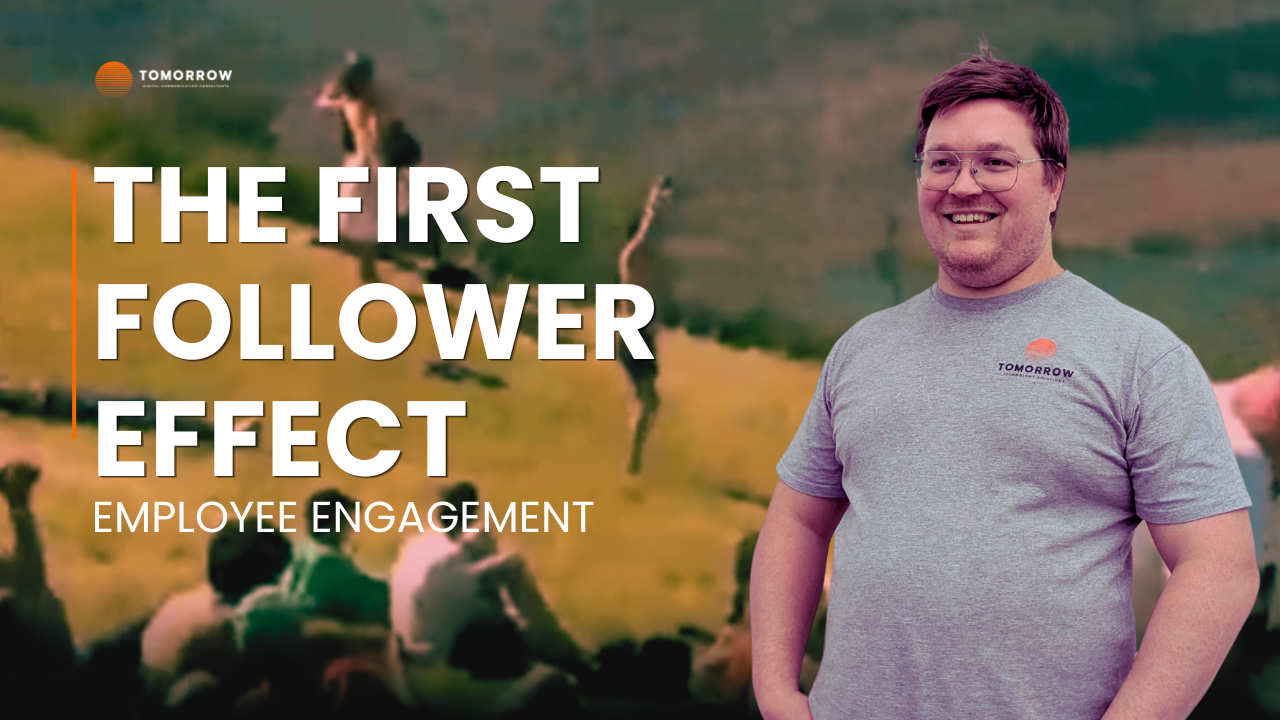
In a famous TED Talk, entrepreneur Derek Sivers dissected a video of a shirtless man dancing alone at a music festival.
At first, Sivers describes the dancer as a "lone nut." Standing alone, making a scene, and risking public ridicule.
"A leader needs the guts to stand alone and look ridiculous... But the first follower is what transforms a lone nut into a leader."
— Derek Sivers
WATCH HERE
When a company page posts on LinkedIn, Facebook, or Instagram, I ask my clients to start thinking about it like that shirtless dancer.
It is the first act of putting an idea into the feed and standing completely alone.
For your audience scrolling past an idea in its inception, interacting with a post that has zero engagement feels risky.
Human beings rely heavily on social proof—a psychological trait where we naturally mirror the choices and behaviours of others as a result of assuming the crowd has more information, or that their behaviour is the correct path.
If nobody is engaging with your content, your audience subconsciously makes two quick assumptions:
- This content isn't important or valuable.
- It’s a social risk to be the first person to comment.
For your staff, staying silent isn't an act of laziness—it’s pluralistic ignorance. Employees and external followers alike hesitate simply because they are waiting to see how everyone else reacts first.
How Employee Advocacy Drives Organic Reach
Everything changes in the video the moment a second person steps up and joins the dancer.
As Sivers points out, the first follower plays an under-appreciated role: he publicly shows everyone else how to follow. He validates the leader, removes the stigma of standing out, and signals to the crowd that it’s safe to join in.
Soon, a second follower joins. Three is a crowd, and a crowd is news. Suddenly, a movement forms, and others jump in simply because they don't want to be left out.
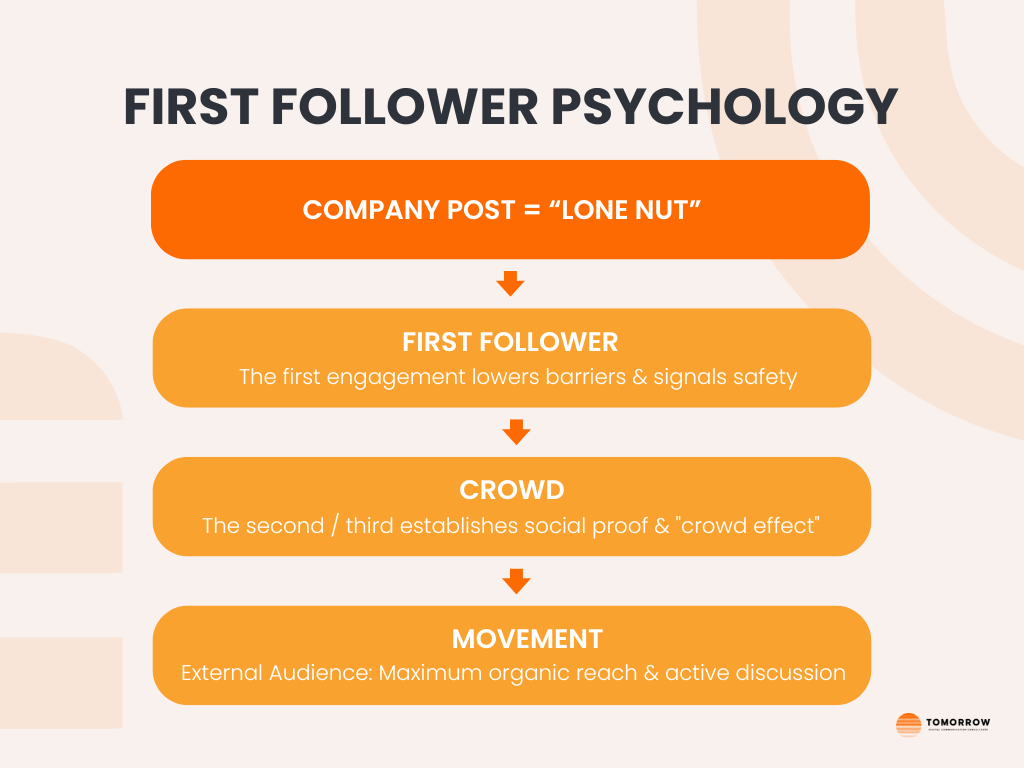
When I coach clients on effective employee advocacy on social media, I tell them: Your employees are your equivalent First Followers.
When your team likes, comments on, or shares a company posts, they aren't just pleasing an algorithm—they are performing a psychological service for your brand:
-
They lower the barrier to entry: A post with 5 likes and 2 employee comments feels like an invitation to join a discussion. A post with 0 likes feels like a corporate broadcast.
-
They grant permission: When prospects see actual team members interacting openly and honestly, it signals authentic culture and credibility.
-
They trigger network effects: When employees engage, platform algorithms push that content into their own personal networks, dramatically expanding your organic social reach.
Ask about our employee engagement workshops
Why Bad Content is a Reputation Risk
This is where most corporate social strategies fail, and it's the elephant in the room most corporations disregard: Employees want to guard their personal reputations, too.
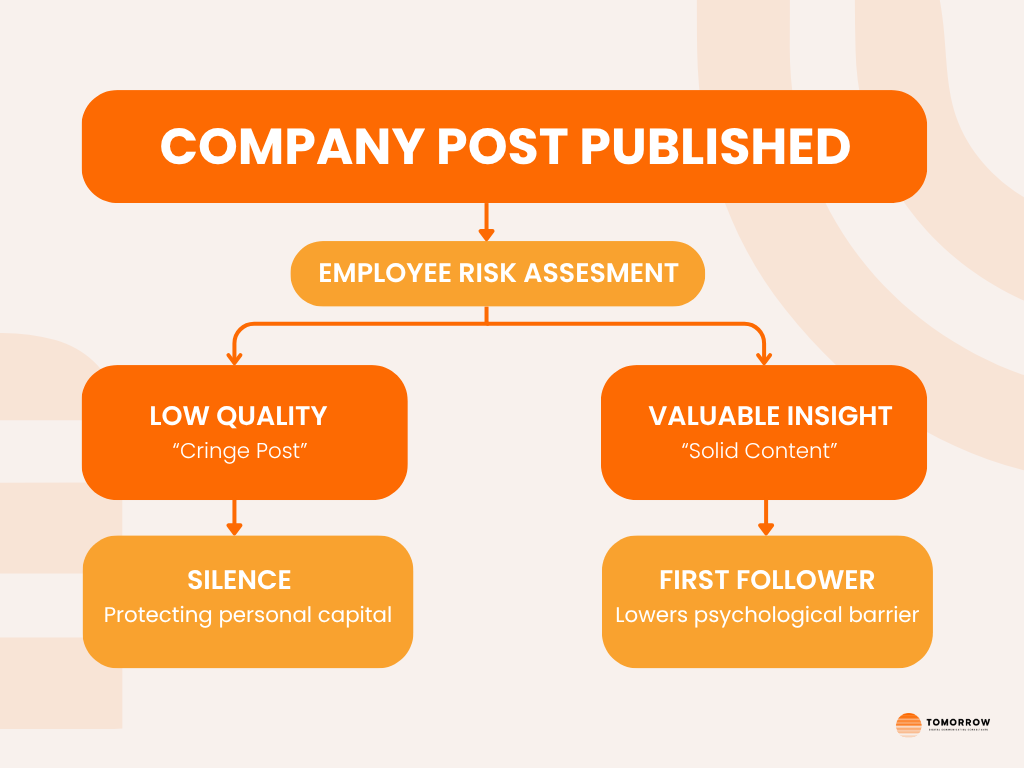
Before an employee will ever step up as your First Follower, their subconscious runs a quick risk assessment:
"If I like or comment on this, will it make me look foolish to my professional network?"
Social media feeds are completely transparent, and staff know that every like or comment holds reputational weight. Their peers, ex-colleagues, and industry contacts will see whatever they engage with. If your company page publishes uninspired content or dry PR releases, your team will likely stay quiet—not out of laziness, but out of embarrassment to publicly endorse content that lacks substance.
The First Follower effect only works if marketing gives the crowd something actually worth following. A successful social media employee engagement strategy doesn't start by demanding more of your employees; it starts by publishing content that your team is genuinely proud to align with.
Leadership Must Take Ownership
So, who is supposed to take that first uncomfortable step?
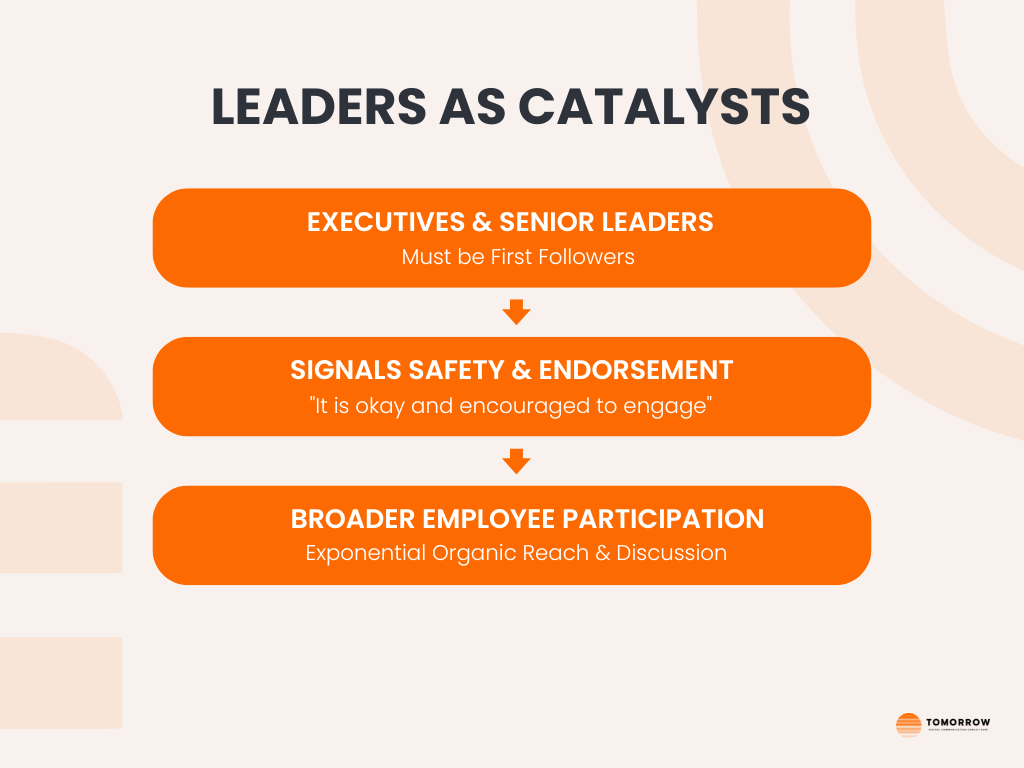
You cannot expect frontline employees to risk their social capital if leadership isn't willing to step onto the dance floor first.
If C-suite executives and senior managers never like or comment on company content, they send an implicit message to the rest of the team: This content isn't important, or worse, engaging on social media isn't a productive use of my time.
Leadership isn't about delegating social engagement to marketing and hoping employees magically follow suit. Executives must be the active contributors (if not First Followers)—publicly validating company ideas, demonstrating authentic interaction, and showing the rest of the team that participation is safe and valued from the top down.
Why Algorithms Don't Create Movements
It’s tempting to treat employee advocacy on social media as a technical hack: “If 10 staff members like this post, the LinkedIn algorithm will boost our reach by 25%.”
While engagement does influence feed distribution, focusing solely on the math misses the point. Algorithms are designed to mirror human behavior. Platforms elevate content because real human behaviour is showing that it matters.
Stages of Employee Engagement
- Employee steps up as "First Follower"
- Removes psychological friction for others
- External prospects join the conversation
- Algorithm recognizes authentic activity
- Organic reach expands naturally
7 Steps to Build an Employee Advocacy Strategy
To transform your team into "First Followers," you don't need to reinvent their routines—you just need to align their existing habits with quality content. Here is how to operationalize this mindset:
1. Pass the "Reputation Test" First
Before asking your staff to engage, ask yourself: Would an employee voluntarily share this with their peers if they didn't work here? If the answer is no, fix the content before you troubleshoot engagement. Respect your team enough to provide content that actually makes them want to contribute and stay informed.
2. Lower the Friction (Make It Easy to Follow)
Since employees are already skimming feeds on their phones, make participation effortless. End company posts with direct, low-friction prompts, and discuss internally how you would like them to lead the charge.
3. Connect Social Activity to Professional Growth
Show employees how engaging on company posts builds their personal credibility and positions them as valued members of an industry-leading organization. When daily scrolling becomes a tool for their own career development, engagement happens organically.
4. Embrace Followers as Equals
When an employee leaves a comment on a company post, executives or page managers should reply promptly. Treat their input with genuine appreciation. When leadership embraces early followers as equals, the dynamic shifts from top-down broadcasting to true community building.
5. Clear Up Social Media Guidelines
Employees often refrain from commenting because they fear saying the wrong thing or violating company policies. Provide clear, encouraging social media guidelines that explicitly give staff permission to share their authentic opinions.
6. Celebrate Your Internal Champions
Recognize team members who consistently step up to kickstart conversations on company posts. Highlight them in internal meetings or communications. Remind your team that being the spark that starts the fire is a valuable form of leadership.
7. Train for Proactive Autonomy (Don't Micromanage Engagement)
Employees shouldn't need a nudge to leave a comment. When staff are trained properly on the value of social proof, they naturally recognize an unengaged company post as an opportunity to be productive. Proper enablement turns engagement into a proactive instinct rather than an assigned task.
Ask about our employee engagement workshops
The Key Takeaway for Leaders
If your a leader trying to lead a social media employee engagement initiative it's important to remember that this isn't about asking your team to spam bad content; it’s about creating worthy ideas and cultivating a culture where employees feel safe—and proud—to represent you.
The next time your company prepares to hit "publish," make sure the content is worthy of your team's reputation, and empower them to be the first followers—because there is no movement without them.
ABOUT US
DIGITAL MARKETING CONSULTANTS
Tomorrow embed inside $1M–$10M professional services to turn complex expertise into high-converting content systems that capture attention and drive growth.