Why Genuine Connection Beats LinkedIn Automation
The Human Side Of LinkedIn
When commercial leaders think about using LinkedIn, most default to a broadcast marketing mindset. Yet, treating LinkedIn purely as a content engine means overlooking its greatest commercial function: peer-to-peer relationship building.
On an episode of the Creative Business Podcast, host Brad Eather sat down with social selling pioneer Mic Adam—LinkedIn member #488,825 of over one billion users—to discuss why relationship-driven sales outperforms automation and how B2B professionals can turn quiet networking into a qualified pipeline.
WATCH SEGMENT
What is Social Selling, and Why Does It Outperform Cold Outreach?
Mic argues that sales has always been social. Long before the internet, business was won by identifying prospects, starting conversations, establishing mutual trust, and eventually evaluating commercial fit. Social selling is not a replacement for traditional relationship-building; it is simply the digital execution of it.
The real difference is scale. LinkedIn offers direct access to a global network of professionals, making it easy to locate decision-makers and initiate dialogue. But social selling is not about blasting cold pitches into direct messages. It centres on building credibility through an optimized profile, thoughtful comments, and tailored insights, ensuring that when a commercial conversation eventually happens, mutual trust has already been established.
Why Are Content Metrics Misleading B2B Teams?
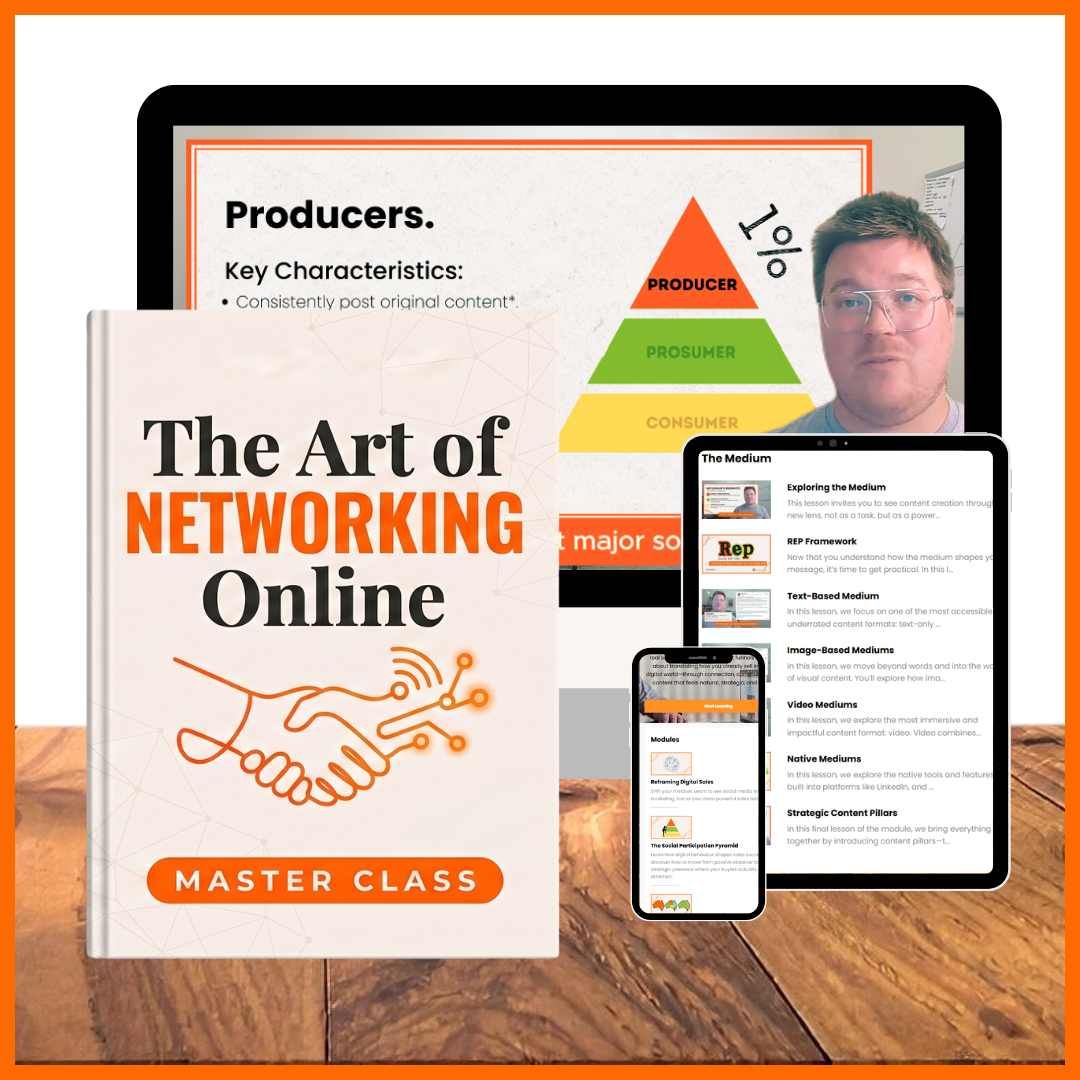
Most marketing advice about LinkedIn focuses heavily on creator playbooks: viral hooks, trending formats, and vanity follower counts. But this advice targets an extreme minority of the platform's B2B user base:
- Under 2% of LinkedIn members post at least once a month.
- Only 10% to 12% actively comment or interact in public feeds.
- Over 85% of members never post or comment publicly—they use the platform for searching, messaging (DMs), and reading professional news.
When commercial teams measure content success strictly through impressions and likes, they optimize for the noisy 2% while missing the silent 85% where senior B2B decision-makers reside.
Enterprise deals rarely require mass audiences. Most sales professionals only need 3 to 50 closed accounts annually to hit their revenue quota. Engaging a curated target list of 100 to 200 relevant accounts will consistently yield higher contract value than broadcasting to 50,000 disengaged followers
How Can B2B Professionals Create Content Without The Overwhelm?
In today’s market, sales professionals face mounting pressure to participate and build a presence on social media. Yet despite having frontline expertise, many hold back—assuming effective content demands glossy production or hours stolen from high-value selling activities.
To overcome production friction, apply the REP Framework: keep your B2B content Repeatable, Efficient, and Practical.
- Substance beats production: A concise, insight-rich text post routinely outperforms high-budget video because peer insights resonate far more than corporate campaigns.
- Mine your calendar for topics: Turn routine questions from client consultations into focused posts. Solving one buyer’s challenge publicly directly helps dozens of leads facing the same roadblock.
- Target decision-makers, not algorithms: Ignore vanity metrics. Fifty views from qualified decision-makers will build a stronger commercial pipeline than thousands of passive likes.
What Does an Effective 25-minute LinkedIn Routine Look Like?
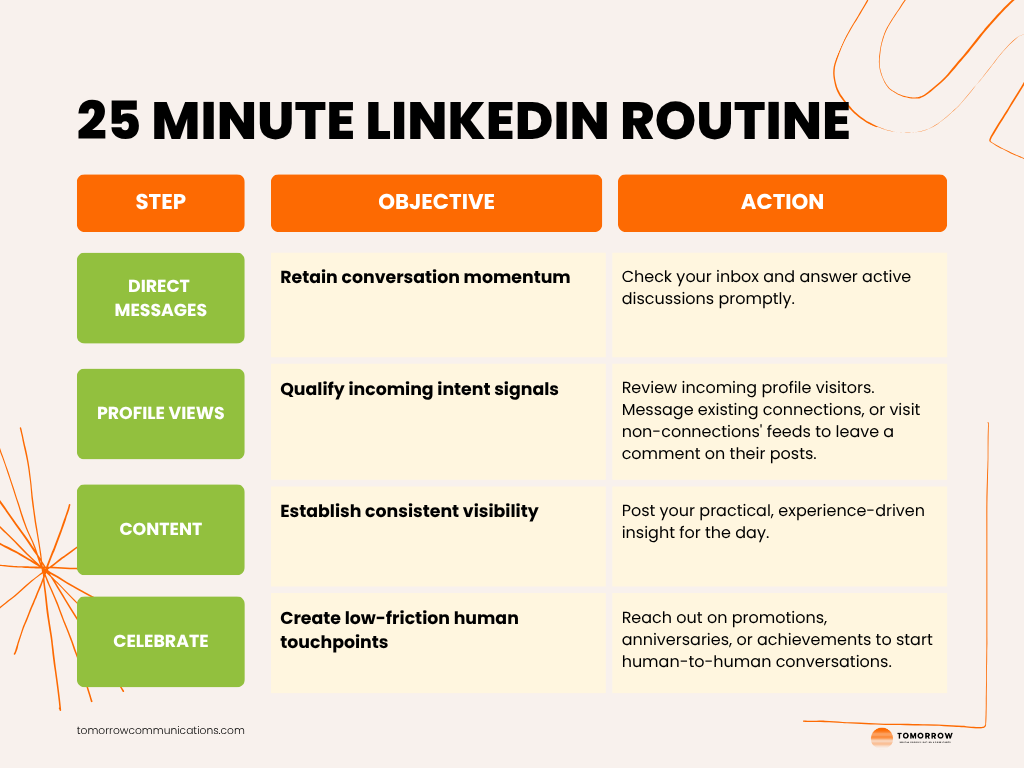
Scrolling LinkedIn indefinitely leads to diminishing returns. Adam advocates for a disciplined, time-boxed routine that takes roughly 25 minutes each morning to drive consistent pipeline without hijacking your day:
How Do You Turn LinkedIn Profile Views into Qualified Clients?
On LinkedIn, a profile visit is an active intent signal indicating someone noticed your contributions and paused to evaluate your professional credibility. Because over 85% of users browse silently, incoming profile visits represent one of the clearest early indicators of buyer interest.
However, high-value prospects won’t visit your profile on their own—you have to earn their attention first. Instead of relying on disruptive cold InMails, use strategic comments to get noticed and pull decision-makers to your profile:
- Curate a targeted watch list: Track key accounts via Sales Navigator or a spreadsheet rather than scrolling the main feed.
- Drive views with insightful comments: Leave substantive observations on prospects' daily posts to spark name recognition and intentional profile visits.
- Leverage the 5-touch threshold: After roughly five interactions, prospects often connect inbound; if not, your outbound request converts at an 80%+ rate due to established familiarity.
- Surround the buying committee: Engage adjacent stakeholders—operational managers, finance leads, and executive assistants—to cultivate internal champions before vendor decisions happen.
Why Does AI Automation Fail to Build High-Ticket B2B Relationships?
The proliferation of generative AI has led to an influx of generic connection sequences, template-driven comments, and automated scraping tools. In high-ticket enterprise sales, this approach carries reputational risk:
- Platform Compliance: Mass automation tools violate LinkedIn’s User Agreement, putting commercial profiles at risk of suspension or bans.
- Reputational Degradation: Savvy B2B buyers readily identify AI-written platitudes. When you automate your critical thinking, you forfeit your professional credibility.
Mic notes that while AI can assist in checking grammar or structuring thoughts, a human must retain complete ownership of both the input and the final output. Before publishing anything, ask yourself: Am I proud to put my name to this piece of work? If the answer is no, do not post it.
LISTEN HERE
How Can Sales and Marketing Align Through Employee Advocacy?
Employee advocacy is the practice of team members leveraging their personal networks to promote company content and build brand authority. However, these programs fail when treated as a one-way broadcasting tool—where marketing writes copy and expects sales reps to reshare it like automated channels.
To drive sustainable pipeline, advocacy must operate as an active, bidirectional feedback loop:
- Sales to Marketing: Sales reps sit on the front lines, fielding real-time buyer objections, technical hurdles, and market shifts. Funnelling these direct customer interactions back to marketing provides the raw data needed to build high-impact campaigns.
- Marketing to Sales: Marketing refines those field insights into structured frameworks, sharp collateral, and context-rich assets that reps can naturally share in one-on-one prospect dialogues.
When backed by ongoing executive support, advocacy becomes an integrated, relationship-driven growth engine.
To hear the complete discussion, listen to the full episode of the Creative Business Podcast featuring Brad Eather and Mic Adam, author of "MIC DROP: The Human Side of LinkedIn".
ABOUT US
DIGITAL MARKETING CONSULTANTS
Tomorrow embed inside $1M–$10M professional services to turn complex expertise into high-converting content systems that capture attention and drive growth.