Unpacking High Performance Culture and Psychological Safety with Neil Tunnah
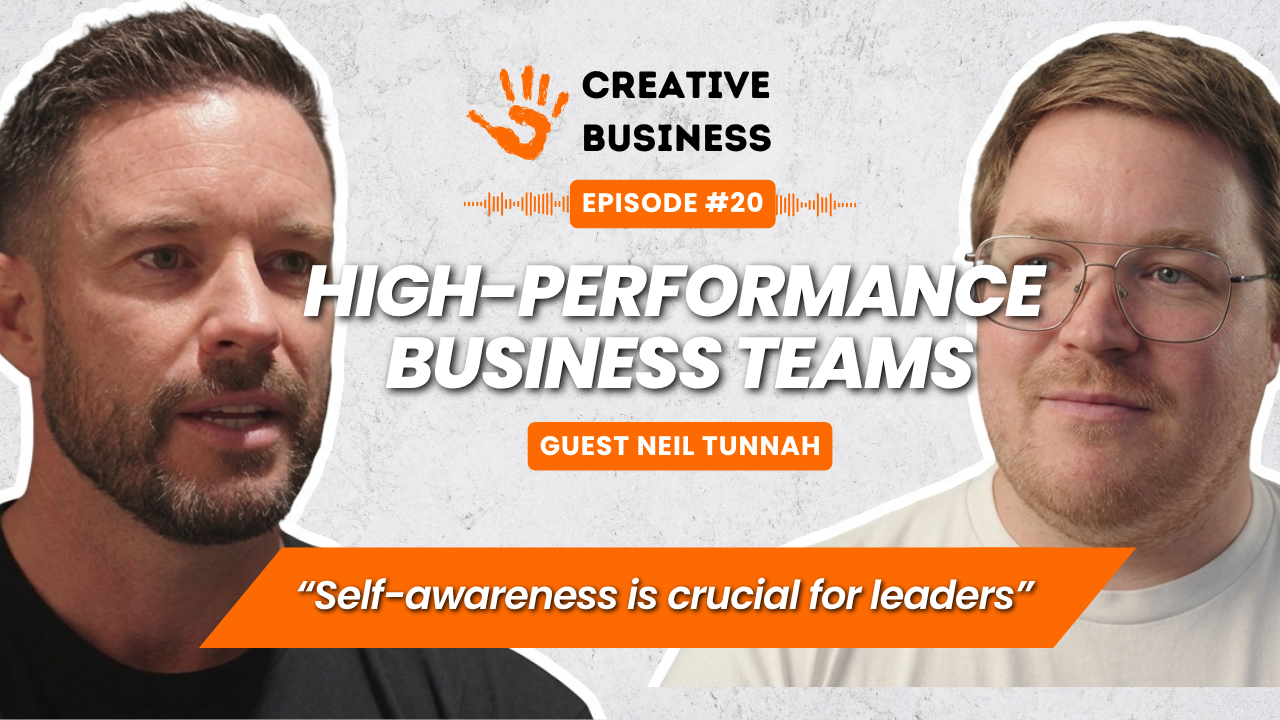
CREATIVE BUSINESS PODCAST | EP 20
Every day on social media platforms there is an endless parade of self-proclaimed experts offering simple blueprints for corporate success. In the latest episode of Creative Business Podcast, host Brad Eather and high-performance coach Neil Tunnah sat down to dismantle these corporate myths.
From the Field to the Boardroom.
Drawing from over 25 years of experience building elite teams (in professional sports and corporate arenas), Tunnah understands the gap between athletic discipline and commercial execution to offer a deeply human, data-driven framework for modern leadership.
LISTEN NOW
High-Performance Teams: Transforming Business Culture with Sporting Tactics
Dismantling Leadership Misconceptions: Why Motivational Speeches Fail under Pressure.
Business leaders often romanticize high performance, envisioning themselves delivering dramatic speeches to rally a struggling team . However, the reality inside elite locker rooms is starkly different.
Tunnah points out that motivation is deeply individualized. While seasoned pros are often self-drive, younger talent requires a individualised, intentional system that builds their motivation to reach a "game-ready" state.
Defining Individual Contributors: Turning Strategic Clarity into Confidence
True confidence in the workplace isn't an emotion, it is a by-product of alignment. Citing a lesson from former Wallabies coach Dave Rennie, Neil notes that "Clarity Creates Confidence". However, the trap leaders fall into is assuming their own clarity translates perfectly to their team.
To accurately an define individual contributor success, a leader must practice their active listening skills. Listening allows a manager to recognize how a message is being received, ensuring that standards expected are crystal clear to the person executing the task.
When this communication is sharp, organizations can successfully deploy strength-based modelling to get the most out of the individuals within their teams.
WATCH NOW
Managing Outliers: How to Address the "A-Player" Performance Divide
Almost every leader has encountered a corporate outlier: the superstar salesperson or technical mind who hits 200% of their target but leaves a trail of cultural destruction in their wake. Too often, management looks the other way to protect the numbers.
Neil warns that this creates a toxic performance divide. When a team sees a leader tolerate selfish behaviours, the performance of the rest of the unit begins to dip.
Fixing this requires organizations to establish fluid feedback cadences that move away from the "90-day review". His argument is that a leader cannot expect to coach a team effectively if they wait three months to address a behavioural issue that occurred on day three.
It takes courageous, real-time coaching to step into those uncomfortable spaces, manage the egos, and protect the collective cohesion of the unit.
Psychological Safety in the Workplace: Reframing Culture as a Performance Multiplier
Perhaps the most crucial part of this conversation tackled the lingering corporate stigma surrounding workplace culture. Neil approaches the concept through a purely operational lens, reframing psychological safety at work as a bottom-line strategy.
When employees operate in a state of fear (i.e being anxious about making mistakes or being publicly put on the spot) the human brain undergoes a physiological shift. Under acute stress and fear, an individual's actual capacity to learn, adapt, and process information drops to less than 10%.
Logically then, Tunnah argues that if a leader challenges their people to grow and innovate while using fear to drive standards, they are mathematically handing their team a 90% chance of failure.
Operationalization of Strategy: Passing the Scoreboard Test by Investing In Your People
While markets, competitor pricing, and global politics heavily influence a business, they are external variables over which you have very little actual control. Neil argues that the most powerful, high-impact lever a business can pull is its people. By investing time and resources into recruiting, training, developing, and sustaining individuals, a business can deliver a customer experience that completely outpaces the competition . Human talent is your only true performance multiplier, giving businesses the edge needed to command premium pricing for their services.
But even the most beautiful strategy means nothing if it stays locked away in a top drawer . True organizational growth requires the practical operationalization of these values—transforming high-level strategic goals into daily habits and clear behaviours that support consistent execution
To pull this off effectively, Neil suggests a simple framework for your team's creativity . Every time you open up the floor to innovate, keep the train on the tracks by asking one question: "Does it change the scoreboard?" If the idea directly drives results, run with it; if it doesn't, protect your team's time and keep moving forward.
🍊 Creative Business is brought to you by Tomorrow | B2B Marketing & Communications.