B2B Sales: How To Define, Quantify and Communicate Your Services Value
Every B2B sales professional has a love-hate relationship with the word "value."
We pitch our value propositions, attend value-focused conferences, and promise value to our prospects. But if you were asked right now to write down a definitive definition of value in 5 words or less, could you do it?
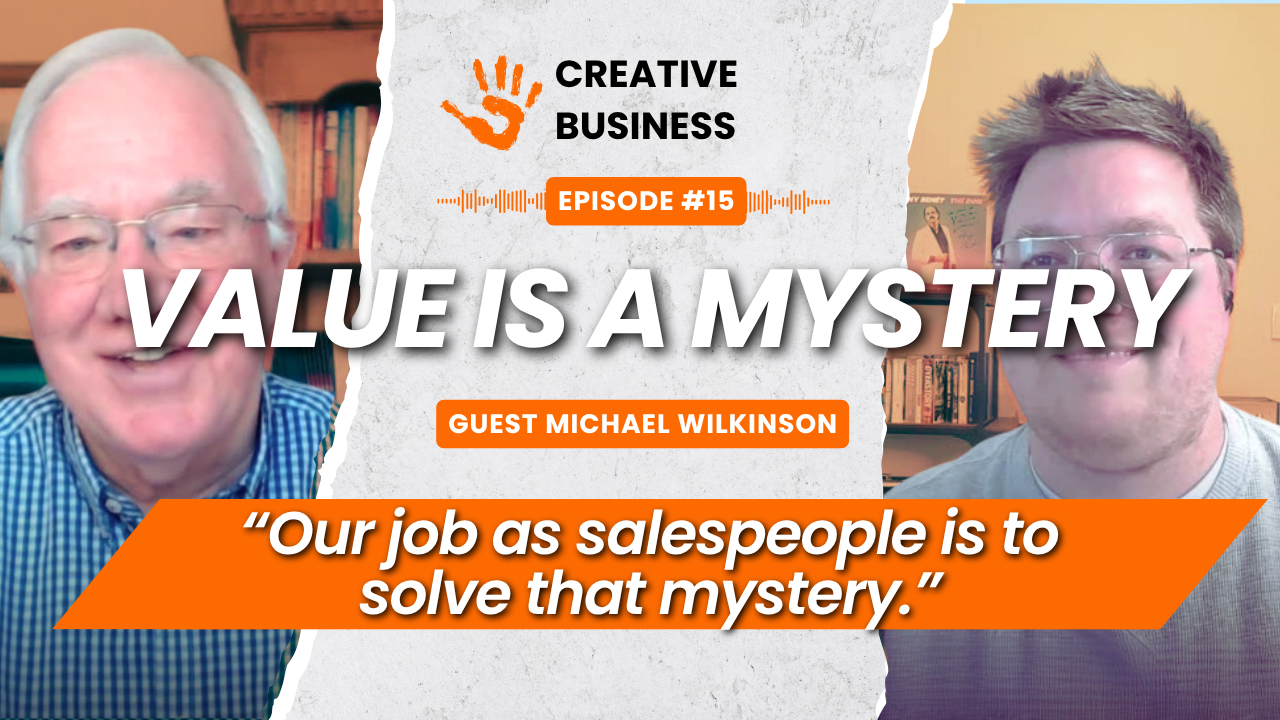
In a truly valuable episode of the Creative Business podcast, host Brad Eather talked with Michael Wilkinson, co-author of The Value Challenge and creator of the value challenge framework, to unpack why value remains such an elusive concept—and how, when you master it, top sales professionals can stop defending their price.
Value is a Mystery to Most Sales Teams
In 2006, Wilkinson was speaking to a room of 100 chemical sales engineers in Copenhagen. The night before, almost every single one of them proudly told him that what they sold to their clients was "value."
The next morning, Wilkinson threw a curveball. He asked each table to write down a dictionary definition beginning with the words "Value is..."
It took twenty minutes of visible struggling for the cards to come back. Every single definition was different, but one card stood out telling the stark reality in just two words: "Value is a mystery."
"Until we understand what our customers see as being valuable, we can only guess," Wilkinson warns . "We may be able to make educated guesses, but at the end of the day, the most important part of value is that value is defined by the customer, not by us."
Your job as a seller isn't to invent value from thin air; it’s to solve the mystery for the specific buyer sitting across from you.
To guide sales teams from initial contact to long-term account growth, Wilkinson distilled the sales journey into seven distinct hurdles that every professional must navigate:
LISTEN NOW
The 7 Challenges of Value Based Selling
To successfully transition from a product-pusher to a trusted advisor, Wilkinson points out that sales teams must navigate seven distinct, compounding challenges throughout the customer journey
1. Understand Value
You must master value both as a core commercial concept and in terms of what it explicitly means to your customer's bottom line . Get this wrong, and the remaining six challenges become an uphill battle .
2. Recognize Changing Value Perceptions
Value is a moving target . What a economic buyer values today will change in a week due to shifting macroeconomics, new tariffs, budget cuts, or internal corporate restructuring.
3. Identify People Who Care About Value
Filter out buyers who only look at the bottom-dollar price and find the stakeholders who are genuinely invested in business outcomes.
4. Differentiate Value Meaningfully
True differentiation only occurs when you are different in ways that your specific customer actively values.
5. Communicate Value Effectively
If you can't articulate your worth, you don't have any . Tailor your messaging around the exact business gaps the customer explicitly told you they need closed.
6. Share in the Value (Pricing Effectively)
To move past vague promises like "we will save you money." You must mathematically monetize the impact of your solution on their business to justify your price and confidently defend against downward pricing pressure.
7. Deliver the Promise
The ultimate test of trust. Sales numbers mean nothing if your operations team drops the ball . Remember: up to 59% of a B2B buying decision is driven entirely by the holistic customer buying experience.
How to Define Value From Your Customers Perspective: 📐
To take the guesswork out of the equation, Wilkinson developed the value triad model, dividing value into three core components—two tangible, and one intangible:
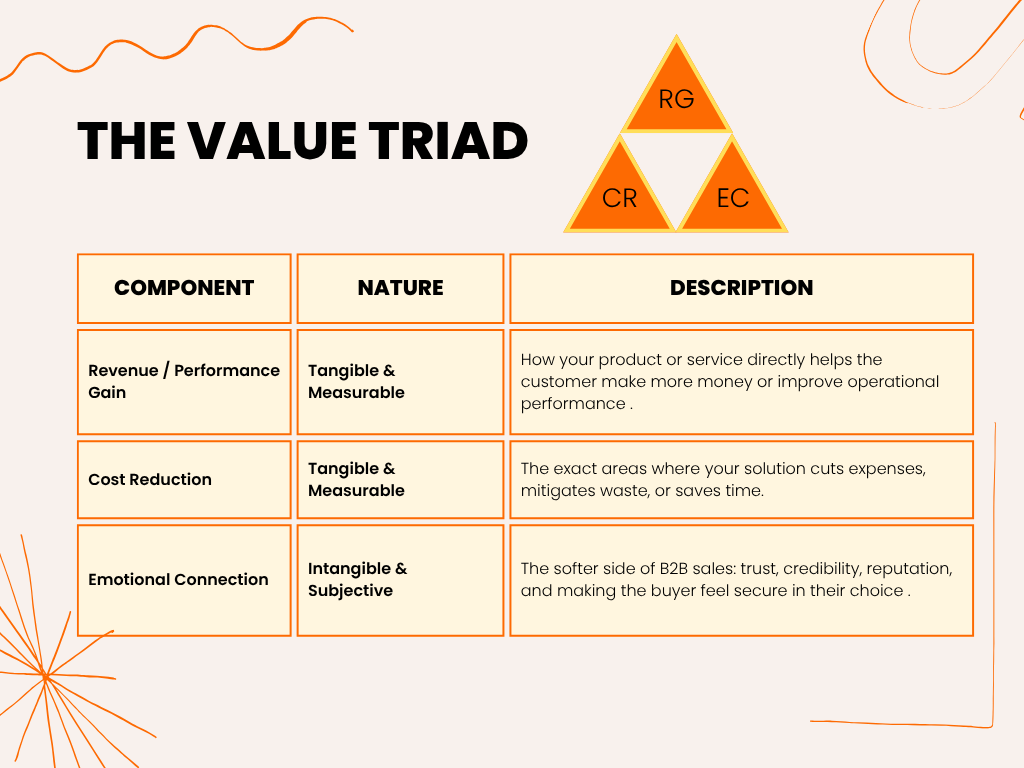
To use the tangible sides of the triad, you must become a student of your customer's business . You can't credibly claim you will reduce their costs or increase their performance if you don't look at their actual commercial realities to see where they are currently losing money.
For the intangible side—Emotional Connection—Wilkinson highlights a distinct sales superpower: the ability to summarize. Actively listening and playing back a prospect's challenges in their own words proves you care more about their success than your commission check.
5 Valuable Steps to Understand Your Sales Process
To operationalize this, Wilkinson relies on a five-step sales process built on peer-to-peer collaboration rather than high-pressure pitches:
1.Assess Your Opportunities
Look at your pipeline with ruthless honesty . Answer two questions: Do we actually want this business? (Are they profitable, or a pain in the ass?) and Can we realistically win it? If the answer to either is no, stop flogging a dead horse and move on.
2.Value Discovery
This is a peer-to-peer exploration, not an interrogation. The real selling is done entirely during discovery. By asking well-crafted questions, the customer naturally sells themselves as they vocalize the depth of their own problems.
3.Value Demonstration
By the time you present a formal proposal, written presentation, or value calculator, there should be zero surprises. This step is simply a formal confirmation of the solutions the customer already expects you to deliver.
4.Value Delivery
This is where the sales promise meets real-world execution. Ensure seamless onboarding to protect the thread of trust you built during the deal cycle.
5.Value Development
Closing the deal isn't the finish line. True account growth happens when you continuously network across the client's business, uncover new challenges, and expand your value footprint.
WATCH SNIPPET
Why Curiosity Overcomes Pricing Objections.
When asked for the single best piece of advice he could offer to modern B2B sellers, Wilkinson’s answer was short: Slow down.
Average salespeople rush through discovery because they are anxious to get to the "sexy bit"—demoing their product or showing off features. But rushing creates friction.
Data consistently shows that the top quartile of B2B solution sellers score exceptionally high in an innate human trait: deep, constructive curiosity.
When you slow down and let your curiosity lead the conversation, you uncover the cascading commercial impacts of a prospect's problem. Paradoxically, spending more time asking strategic questions in discovery actually speeds up the overall sales velocity.
In an era of endless digital noise, buyers don't need another brochure-carrier or a feature-dumper. They need a trusted partner curious enough to help them cut through the clutter and make a confident, bulletproof buying decision.
🍊To hear more conversations exploring the intersection of creativity and commerce, subscribe to the Creative Business podcast on your preferred podcast platform.
ABOUT US
DIGITAL MARKETING CONSULTANTS
Tomorrow embed inside $1M–$10M professional services to turn complex expertise into high-converting content systems that capture attention and drive growth.