Agents vs. Automation: What Small Business Needs To Know About AI
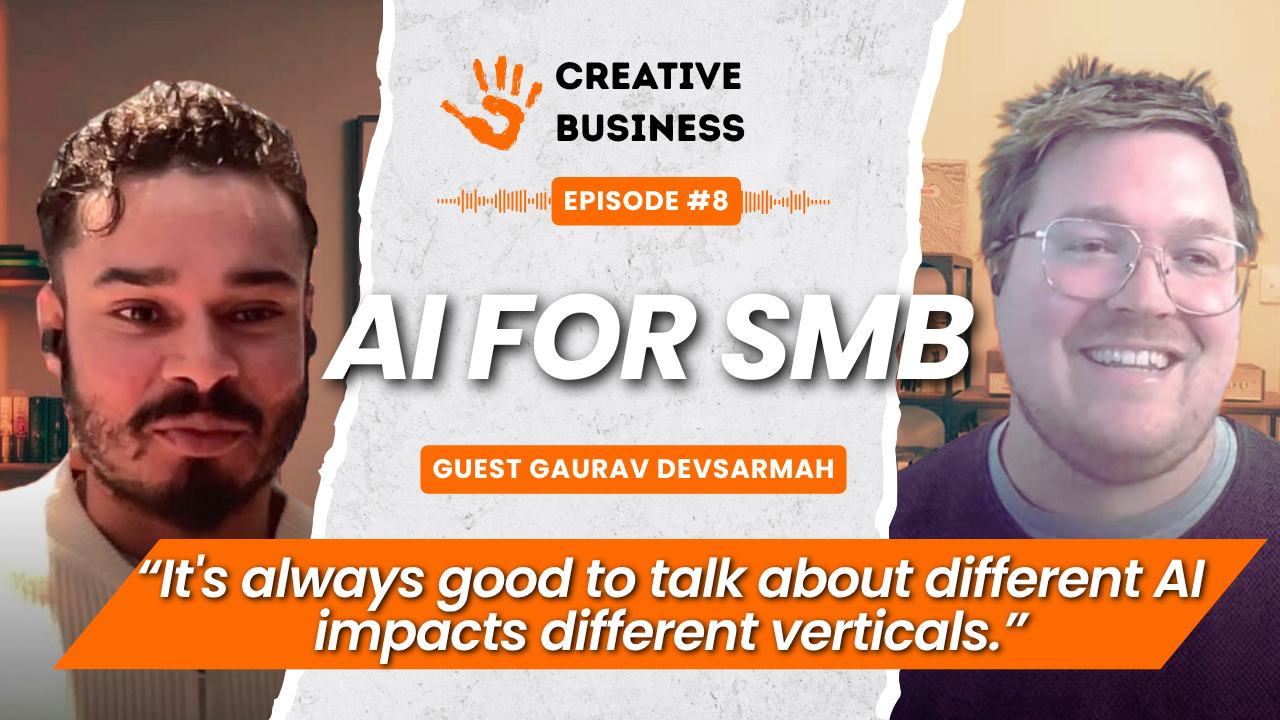
The landscape of artificial intelligence is moving too fast for traditional business approaches to keep up. Many leaders find themselves overwhelmed by conflicting opinions and technical complexity.
In this episode of the Creative Business Podcast, host Brad Eather sat down with Gaurav Devsarmah, Head of AI Strategy and Solutions at Warp Development, to discuss how small and medium-sized businesses (SMBs) can leverage custom AI to build operational value, protect institutional knowledge, and redefine client relationships.
LISTEN HERE
The Operational Shift: AI Agents vs. Automation
For years, the corporate world has become "SaaS-ified," leaving enterprise data scattered across dozens of disconnected tools. When optimizing these systems, it is important to understand the distinction between AI agents vs automation.
Traditional automation relied on predictable parameters. It required developers to hard-code a set solution for every single step along predefined paths. If an unexpected edge case arises, the automation breaks.
Conversely, an AI agent operates on dynamic evaluation. Instead of relying on hard-coded scenarios, an active AI agent is given an overarching goal and the autonomy to decide on the fly whether to execute path X or path Y to achieve an optimal outcome.
At an enterprise level, this means securely connecting centralized data repositories—such as SharePoint—to a Large Language Model (LLM) within protected cloud environments like AWS. This architecture allows businesses to process complex qualitative data, uncover operational patterns, and autonomously execute tasks without leaking private company IP to third parties.
Bypassing Legacy Software for Small Business Growth
Implementing a practical AI strategy for small business should always be about solving the core problems affecting stakeholders.
For example: A major advantage of modern AI solutions is their ability to let niche industries bypass traditional digital transformation steps. Historically, sectors like manufacturing struggled to transition operations from a simple spreadsheet to complex ERP or CRM systems because they lacked specialized in-house expertise. AI has changed this dynamic, allowing companies to leapfrog directly from manual spreadsheets to custom software solutions built on top of their existing data.
However, making these technology systems effective relies on a foundational data modelling rule: garbage in, garbage out.
To keep systems functional, organizations need to adopt proactive data hygiene practices and format documentation appropriately for AI.
To do this, leaders should be intentionally designing documentation for AI comprehension by:
- Utilizing structured formats like Markdown (.md) files to feed clear instructions to models.
- Eliminating version-control confusion caused by duplicate files with random edits.
- Writing plain-text rationale alongside complex spreadsheets so the AI understands the underlying financial logic or formulas.
Preserving the Core: AI Knowledge Retention for Retiring Employees
One of the most immediate, high-value applications of custom AI architecture addresses a corporate risk: the loss of institutional intelligence.
Across almost every industry, veteran employees with decades of experience are reaching retirement age. When they walk out the door, decades of undocumented operational IP vanish.
Forward-thinking organizations are prioritizing AI knowledge retention for retiring employees to quantify this undocumented brain trust. Through systematic guided interviews and documentation, businesses can capture this deep domain expertise, feed it directly into a secured enterprise agent, and turn fleeting human experience into a permanent, systemized piece of company procedural IP.
WATCH CLIP
Expanding Operational Capabilities: The Future of Workflow Innovation
The true value of AI in business extends far beyond automating tasks; it has the potential to reshape organizational communication capability.
For example: As AI reaches saturation with automated ‘personalized’ outreach, prospects have become desensitized to messaging. To break through this noise, forward-thinking organizations are changing the way they deliver value, pivoting away from one-sided presentations toward more collaborative styles of client co-creation.
Rather than taking manual notes during a discovery session only to return with a static proposal a week later, teams are leveraging real-time AI transcriptions to feed client requirements directly into pre-determined wireframing tools. This process is allowing businesses like Tomorrow to co-create visual mock-ups and functional systems architecture instantly alongside their clients.
Ultimately, AI has commoditized static information. True competitive advantage in this era does not belong to those who use AI to generate more noise, but to the leaders who use it to expand human capability, synthesize disparate technology, and solve real-world operational problems.
🍊To hear more conversations on the intersection of commerce and creativity subscribe to the Creative Business podcast where ever you listen to podcasts.
ABOUT US
DIGITAL MARKETING CONSULTANTS
Tomorrow embed inside $1M–$10M professional services to turn complex expertise into high-converting content systems that capture attention and drive growth.